Static Image
The Static Image node embeds fixed images in your workflow, providing constant image URLs to downstream nodes without requiring user input at runtime.
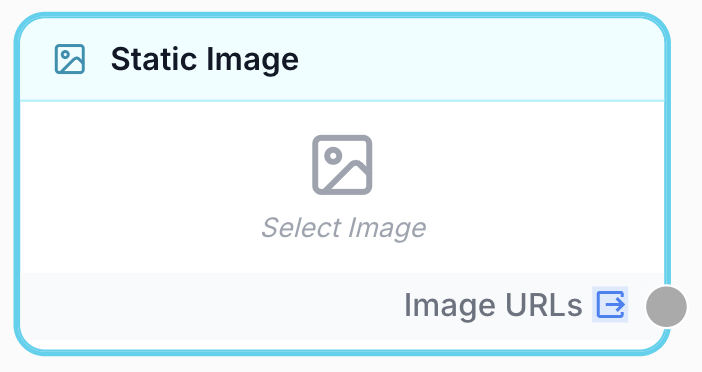
What does the Static Image node do?
The Static Image node lets you embed fixed images directly into your workflow. You upload images once in the node settings, and their URLs are provided to downstream nodes every time the workflow runs — no user input required at runtime.
Common use cases:
- Providing fixed reference images to an Image to Image or Image to Text AI node for consistent processing
- Embedding product photos or brand assets that remain constant across all workflow runs
- Supplying a batch of images to process through a Loop node (e.g., generating descriptions for each)
- Including fixed visual content like logos or templates in automated content generation workflows
Quick setup
Add the node to the canvas
Open the Node Library, go to Inputs > Static, then drag and drop the Static Image node onto your workspace.
Upload your images
Open the node settings and click the upload area to select images from your computer. You can upload up to 15 images at once. Supported formats: JPEG, PNG, GIF, WebP, BMP, and SVG.
Manage your images
Uploaded images appear as a thumbnail grid. Click on an image to select it, then click the delete button to remove it. The node auto-saves after each upload or deletion.
Connect the output
Connect the output port to the next node in your workflow. The node outputs a JSON array of image URLs that downstream nodes can use.
Configuration parameters
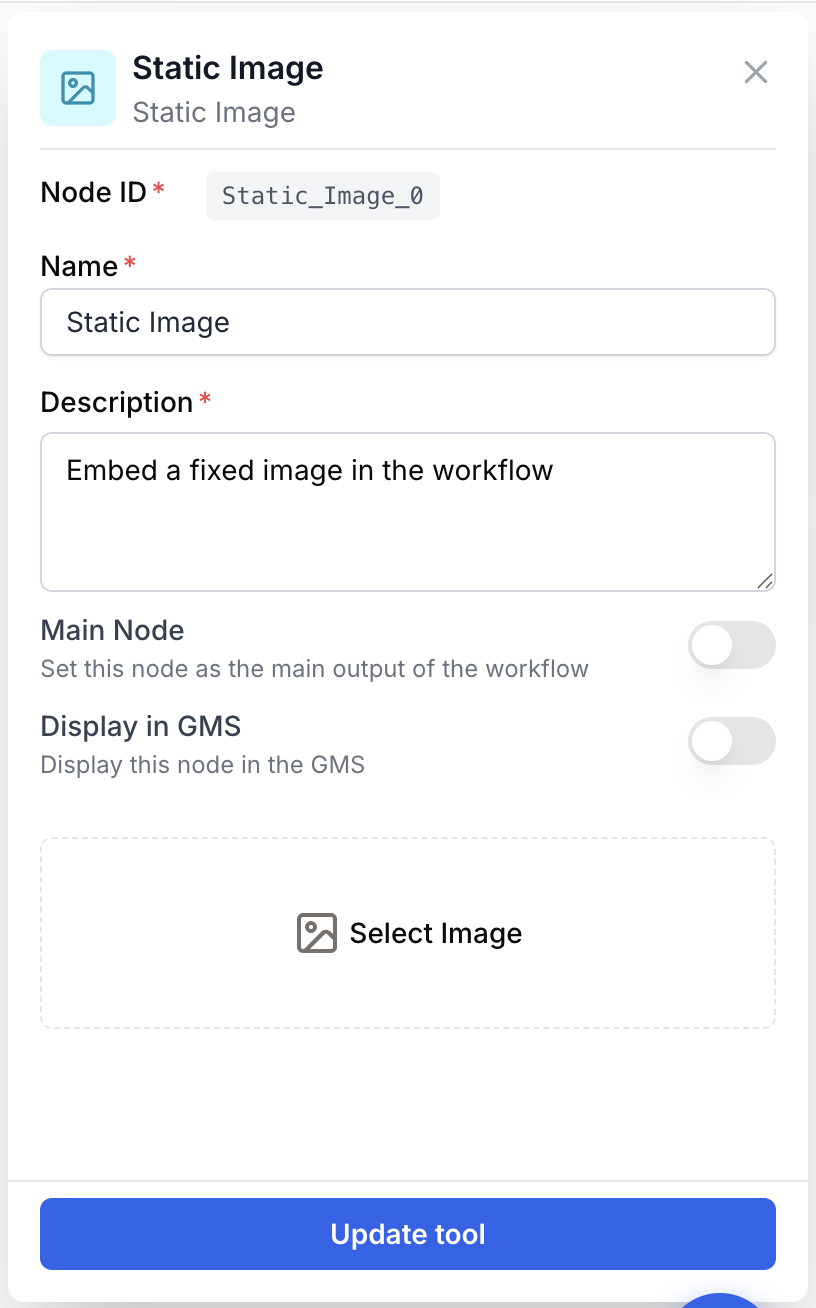
Required fields
Name string required default: Static Image Node name — A label to identify this node on the canvas. Use a descriptive name like “Product Photos” or “Brand Logos” to clarify what images are embedded.
Description string required default: Embed fixed images in the workflow Node description — A short description of what these images are used for in the workflow.
Image upload
Images file Image files — Upload up to 15 images. Supported formats: JPEG, PNG, GIF, WebP, BMP, SVG. Images are stored as workflow assets and their URLs are output as a JSON array.
Changes are auto-saved — every time you upload or remove an image, the node configuration is updated automatically. No need to click a save button.
What does the node output?
The node outputs a JSON array of image URLs as a string. Each URL points to the uploaded image file.
[
  "https://cdn.dng.ai/265254943289683032/image1.png",
  "https://cdn.dng.ai/265254943289683032/image2.jpg",
  "https://cdn.dng.ai/265254943289683032/logo.svg"
]
Image URLs json A JSON array containing the URLs of all uploaded images, in the order they were added.
Usage examples
Example 1: Generate descriptions for product images
You have a set of product photos and want to generate AI descriptions for each one.
Workflow:
- Static Image — Upload all product photos
- Loop — Iterate over each image URL
- Image to Text — Generate a description for each image
- LLM — Refine the description into marketing copy
Example 2: Apply consistent style to reference images
You want to transform a set of reference images using the same AI style.
Workflow:
- Static Image — Upload your reference images
- Loop — Iterate over each image
- Image to Image — Apply the same style transformation to each one
Example 3: Fixed logo in content generation
You want every generated email or document to include your company logo.
Workflow:
- Static Image — Upload your logo
- LLM — Generate HTML content referencing the logo URL
- Email Sender — Send the email with the embedded logo
Best practices
Use Static Image instead of the File input when the images should never change between runs. This keeps your workflow self-contained and doesn’t require the user to re-upload files each time.
Name your node descriptively. Instead of “Static Image”, rename it to “Product Photos” or “Reference Images” so its purpose is clear on the canvas.
Maximum 15 images per node. If you need more, use multiple Static Image nodes and combine their outputs with a Merge node.
Common issues
My image doesn't appear after upload
Cause: The file format may not be supported, or the upload failed silently.
Solution: Make sure the file is one of the supported formats: JPEG, PNG, GIF, WebP, BMP, or SVG. Try uploading again. Check your network connection if the issue persists.
The downstream node doesn't receive the image URLs
Cause: The output port isn’t connected, or the downstream node expects a different format.
Solution: Make sure the output is connected. The node outputs a JSON array of URL strings — if the downstream node expects a single URL, use a JSON Path Extractor to extract the first element.
I reached the maximum of 15 images
Cause: The node has a built-in limit of 15 images.
Solution: Remove unused images, or use a second Static Image node and combine outputs with a Merge node.
How does it fit into a workflow?
Static Image is typically used at the beginning of a workflow to provide fixed visual content:
graph LR
    Static[Static Image] --> Loop[Loop node]
    Loop --> AI[Image to Text / Image to Image]
    AI --> Output[Process results]
Related nodes
Embed fixed text values — the text equivalent of Static Image.
Use File input when images should be provided by the user at runtime.
Analyze uploaded images with AI to generate text descriptions.
Transform uploaded images using AI style transfer or editing.
Iterate over each image URL to process them individually.