Image to Image
Transform existing images using AI models with multi-model support, configurable size, format, and style options
What’s New — April 2026 — Multi-model support (NanoBanana, Flux2, Seedream, Kontext), new parameters (number of images, image size, aspect ratio, output format, custom dimensions), mixed input support (images, URLs, files), error handling options, and template variable support in prompts.
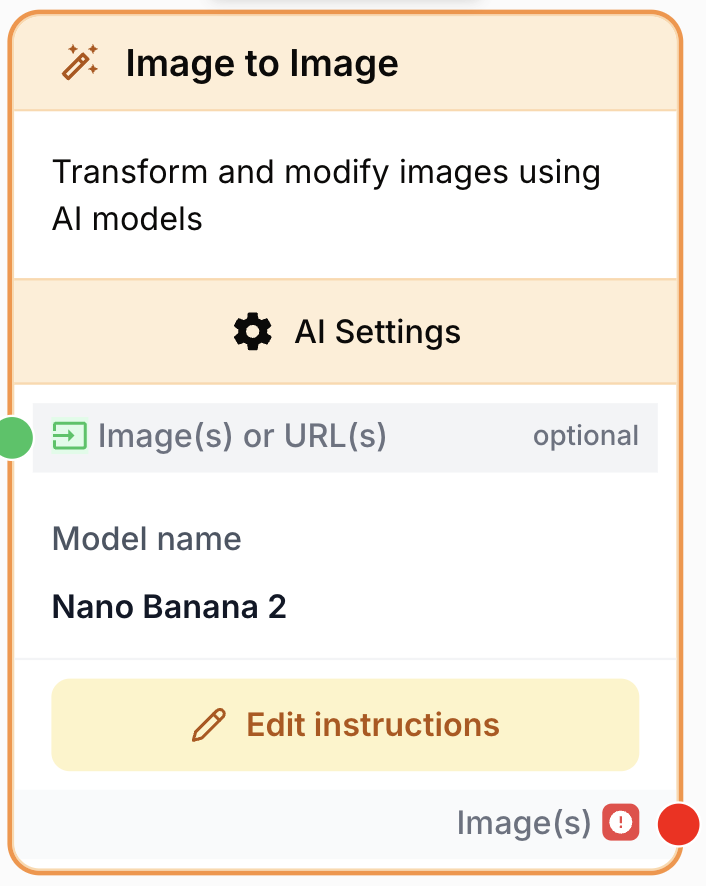
What does the Image to Image node do?
The Image to Image node transforms existing images based on your instructions using a selection of AI models. The node interface dynamically adapts to the selected model, showing only the relevant settings for each model family.
Common use cases:
- Style transfer — Apply artistic styles to photos (e.g., make a photo look like a watercolor painting)
- Image editing — Modify specific elements of an image while preserving the rest
- Background replacement — Swap backgrounds while keeping the subject intact
- Creative remixing — Combine and reimagine source images with AI-driven transformations
Quick setup
Add the Image to Image node
Find it in AI Nodes → AI_IMAGE → Image to Image and drag it onto the canvas.
Provide source images
Connect images to the input_media input port. The node accepts images, URLs, and files. You can provide multiple inputs depending on the model.
Select an AI model
Open the node settings and choose a model from the Model dropdown. Each model family (NanoBanana, Flux2, Seedream, Kontext) offers different strengths and settings.
Describe the transformation
Enter a prompt describing how to transform the image. Be detailed and specific. You can use {{variables}} to inject dynamic values from upstream nodes.
Connect the output
Connect the output port to downstream nodes that accept image data (e.g., Upscale Image, Change Aspect Ratio, or any node that processes files).
Configuration
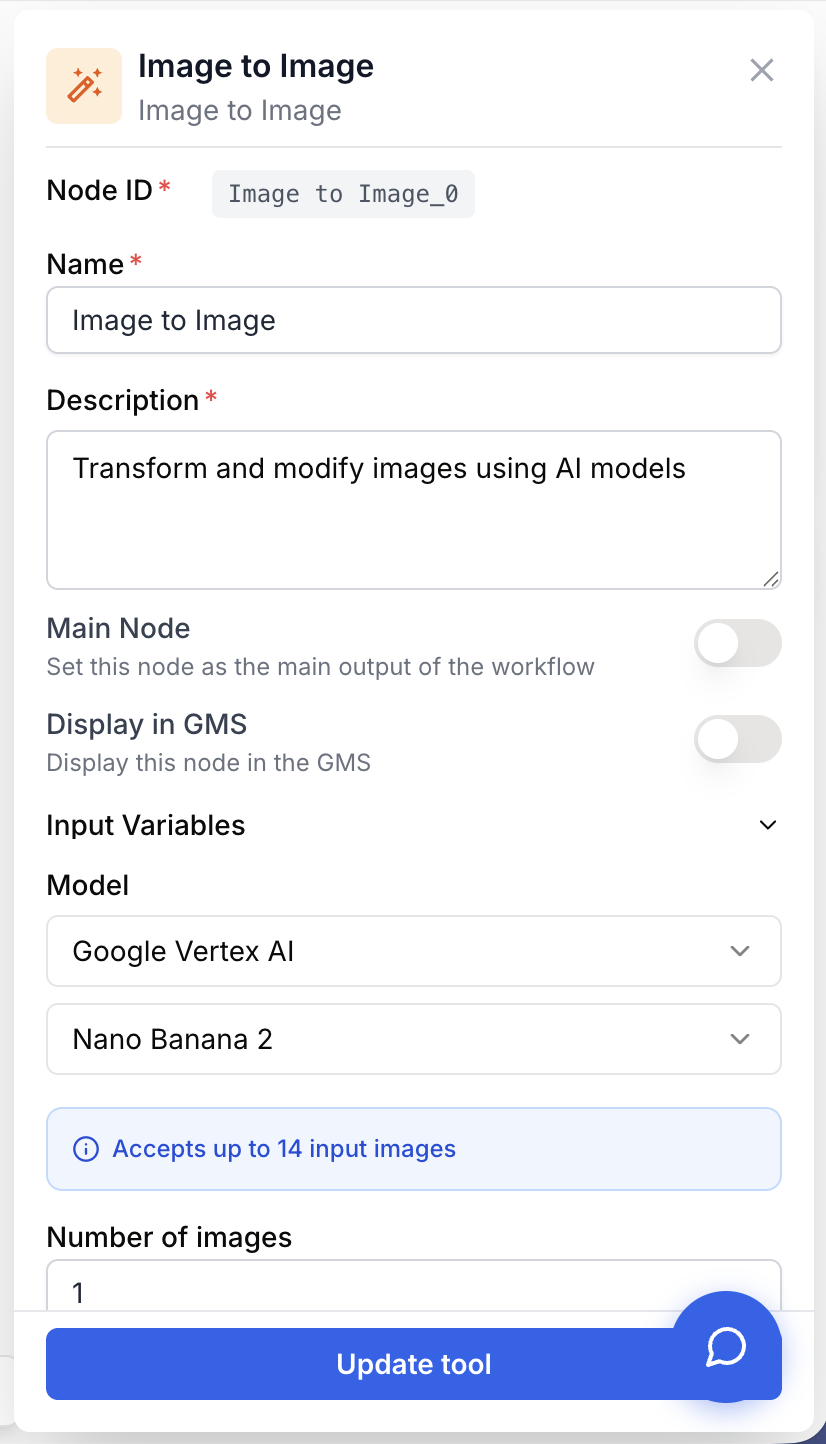
Required parameters
modelName LLM selection required The AI model to use for image transformation. The available settings in the node UI will change dynamically based on the selected model family.
Model families:
- NanoBanana / NanoBanana Pro — Versatile transformation with extensive size and aspect ratio options
- Flux2 Pro & Max — High-quality editing with flexible sizing and custom dimensions
- Seedream v4.5 & v5 Lite — High-resolution output with preset and custom sizes
- Kontext Pro & Max — Focused single-image transformation with minimal configuration
prompt text required Text description of the desired transformation. Supports {{variable}} syntax for injecting dynamic values from other nodes in the workflow.
Tips for effective prompts:
- Be specific about the desired change, style, colors, and mood
- Reference what to keep vs. what to change
- Include artistic direction when relevant (e.g., “oil painting style”, “cinematic color grading”)
Example:
Transform this product photo into a warm, rustic scene.
Place the item on a reclaimed wood table with soft golden
hour lighting from the left. Keep the product unchanged.
With variables:
Apply a {{style}} effect to this image. Keep the subject
intact but change the background to {{background_scene}}.
Optional parameters
input_media media Source images to transform. Accepts images, URLs, and files. The maximum number of input images depends on the model:
| Model | Max input images |
|---|---|
| NanoBanana (Flash) | 14 |
| NanoBanana / NanoBanana Pro | 10 |
| Flux2 Pro & Max | 9 |
| Seedream v4.5 & v5 Lite | 10 |
| Kontext Pro & Max | 1 |
numImages number default: 1 Number of images to generate per execution, from 1 to 4.
imageSize string default: 1K Image size preset. The available options depend on the selected model:
| Model | Available sizes |
|---|---|
| NanoBanana | 0.5K, 1K, 1.5K, 2K, 2.5K, 3K, 3.5K, 4K |
| Flux2 Pro & Max | auto, square, square_hd, portrait, landscape, custom |
| Seedream v4.5 & v5 Lite | auto_2K, 3K, 4K, square, portrait, landscape, custom |
| Kontext Pro & Max | Not available (no imageSize parameter) |
aspectRatio string default: 1:1 Aspect ratio for the output image. Available options vary by model.
NanoBanana and Kontext offer the widest selection: 1:1, 1:4, 2:3, 3:2, 4:3, 4:5, 9:16, 16:9, 21:9, and more.
Other models may use aspect ratio implicitly through size presets (e.g., portrait, landscape).
outputFormat string default: png Output image format.
png— Lossless, larger file size, supports transparencyjpeg— Compressed, smaller file size
customImageSizeWidth number Custom image width in pixels. Only available when imageSize is set to custom.
- Flux2 Pro & Max: 512 to 14142 pixels
- Seedream v4.5 & v5 Lite: 512 to 4096 pixels
customImageSizeHeight number Custom image height in pixels. Only available when imageSize is set to custom.
- Flux2 Pro & Max: 512 to 14142 pixels
- Seedream v4.5 & v5 Lite: 512 to 4096 pixels
errorHandling string default: None How to handle errors during image transformation.
None— Stop the workflow on errorSkip— Skip the failed transformation and continue the workflow
Model-specific settings
The Image to Image node dynamically adapts its interface based on the selected model. Here is a summary of what each model family supports:
NanoBanana / NanoBanana Pro
Versatile image transformation with the widest range of size and aspect ratio options. Sizes range from 0.5K to 4K. Supports a wide variety of aspect ratios including 1:1, 1:4, 2:3, 3:2, 4:3, 4:5, 9:16, 16:9, 21:9, and more. NanoBanana Flash accepts up to 14 input images, while other NanoBanana variants accept up to 10. Output format can be PNG or JPEG.
Flux2 Pro & Max
Full control over output dimensions. Supports preset sizes (auto, square, square_hd, portrait, landscape) as well as custom dimensions from 512 to 14142 pixels. Accepts up to 9 input images. Output format can be PNG or JPEG.
Seedream v4.5 & v5 Lite
Optimized for high-resolution output. Offers size presets from 2K to 4K (auto_2K, 3K, 4K) plus standard presets (square, portrait, landscape) and custom dimensions from 512 to 4096 pixels. Accepts up to 10 input images. Output format can be PNG or JPEG.
Kontext Pro & Max
Focused single-image transformation with minimal configuration. Accepts exactly one input image. No imageSize parameter — output dimensions are determined by the model. Supports the full range of aspect ratios. Ideal for precise, targeted edits on individual images.
Output
output image The transformed image (or images, if numImages > 1). Connect this to any downstream node that accepts image or file inputs.
Examples
Style transfer with Kontext
Apply a specific artistic style to a single image with precise control:
- Model: Kontext Pro
- Prompt:
Transform this portrait into a Renaissance oil painting style. Maintain the subject's likeness and pose but apply classical painting techniques with rich warm tones, dramatic chiaroscuro lighting, and visible brushstrokes. - Aspect ratio:
1:1 - Output format:
png
Batch product photos with NanoBanana
Transform multiple product images into a consistent visual style:
- Model: NanoBanana Pro
- Prompt:
Place this product on a clean marble surface with soft studio lighting. Add subtle shadows and reflections. Professional e-commerce photography style with a light gray gradient background. - Image size:
2K - Aspect ratio:
4:3 - Number of images: 4
- Output format:
jpeg
Creative remix with Flux2
Reimagine an image with custom output dimensions:
- Model: Flux2 Pro
- Prompt:
Reimagine this landscape as a cyberpunk cityscape at night. Keep the general composition but replace natural elements with neon-lit skyscrapers, holographic advertisements, and flying vehicles. Rain-soaked streets with reflections. - Image size:
custom - Width: 1920
- Height: 1080
- Output format:
png
Best practices
Write clear transformation instructions
Be explicit about what to change and what to preserve. Vague prompts like “make it better” produce unpredictable results. Instead, specify the exact style, mood, or modification you want.
Choose the right model for the job
- Use NanoBanana for versatile multi-image transformations with varied size options
- Use Flux2 when you need precise custom dimensions or high-quality edits
- Use Seedream for high-resolution output (up to 4K)
- Use Kontext for precise single-image transformations with minimal setup
Use template variables for dynamic workflows
Leverage {{variables}} to create reusable transformation templates that pull data from upstream nodes. This is especially useful for batch-processing product photos with consistent styling or applying personalized edits at scale.
Match input quality to output expectations
Higher-quality source images generally produce better results. If the input is low resolution, consider using the Upscale Image node first before applying transformations.
Common issues
Model not available in the dropdown
Not all models may be available depending on your plan or configuration. Check your account settings or contact support if a model family is missing.
Too many input images
Each model has a maximum number of input images. Kontext accepts only 1 image, Flux2 accepts up to 9, and NanoBanana/Seedream accept up to 10-14 depending on the variant. Reduce the number of connected inputs if you hit the limit.
Custom dimensions rejected
Custom dimensions are only available for Flux2 and Seedream when imageSize is set to custom. Flux2 supports 512-14142 pixels, while Seedream supports 512-4096 pixels. Extreme aspect ratios may produce distorted results.
Output does not match expectations
Try a more detailed prompt with explicit instructions about what to change and preserve. Switch models if the current one does not support your use case well. For style transfers, Kontext tends to produce the most faithful results on single images.