Google Analytics Property
Select a Google Analytics 4 property as workflow input — runners pick the account and property at runtime.
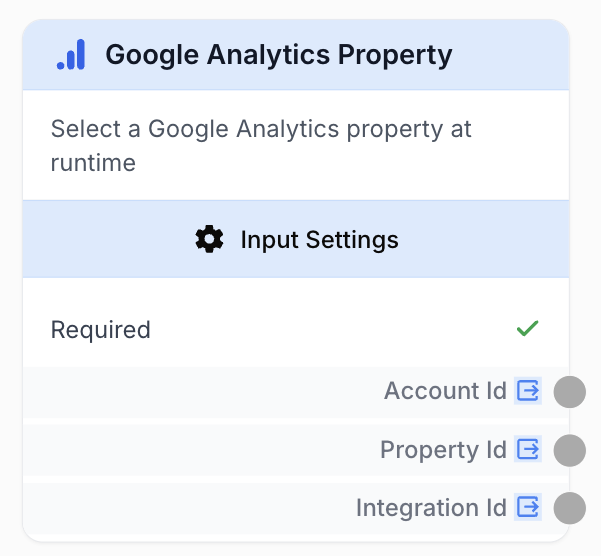
What does the Google Analytics Property node do?
The Google Analytics Property input node lets users pick a Google Analytics 4 property when running the workflow. Instead of hardcoding an account and property in the GA Reader tool node settings, this node creates a runtime selector — the runner picks the GA4 property to query through a cascading flow (integration → account → property).
Common use cases:
- Build reusable GA reporting workflows where each runner targets their own property.
- Process analytics data across multiple properties without duplicating workflows.
- Let team members query their own analytics with a shared workflow.
- Run batch analyses where each CSV row represents a different property.
Quick setup
Follow these steps to add and configure the Google Analytics Property node in your workflow:
Add the node to the canvas
Open the Node Library, go to Input/Output, then drag and drop the Google Analytics Property node onto your workspace.
Connect to a Google Analytics Reader node
Connect the account_id output to the account_id input handle, and the property_id output to the property_id input handle on a Google Analytics Reader tool node. Make sure the GA Reader has the “Use variable” toggles enabled on both Account and Property fields.
(Optional) Pin a fixed integration
In the node settings, enable Fixed integration to lock a specific Google Analytics integration for every runner. Leave it off to let each runner pick their own integration at runtime.
Configure the runtime UI
In the App tab, the runner sees an integration selector (unless pinned), an account dropdown, and a searchable property dropdown.
Configuration parameters
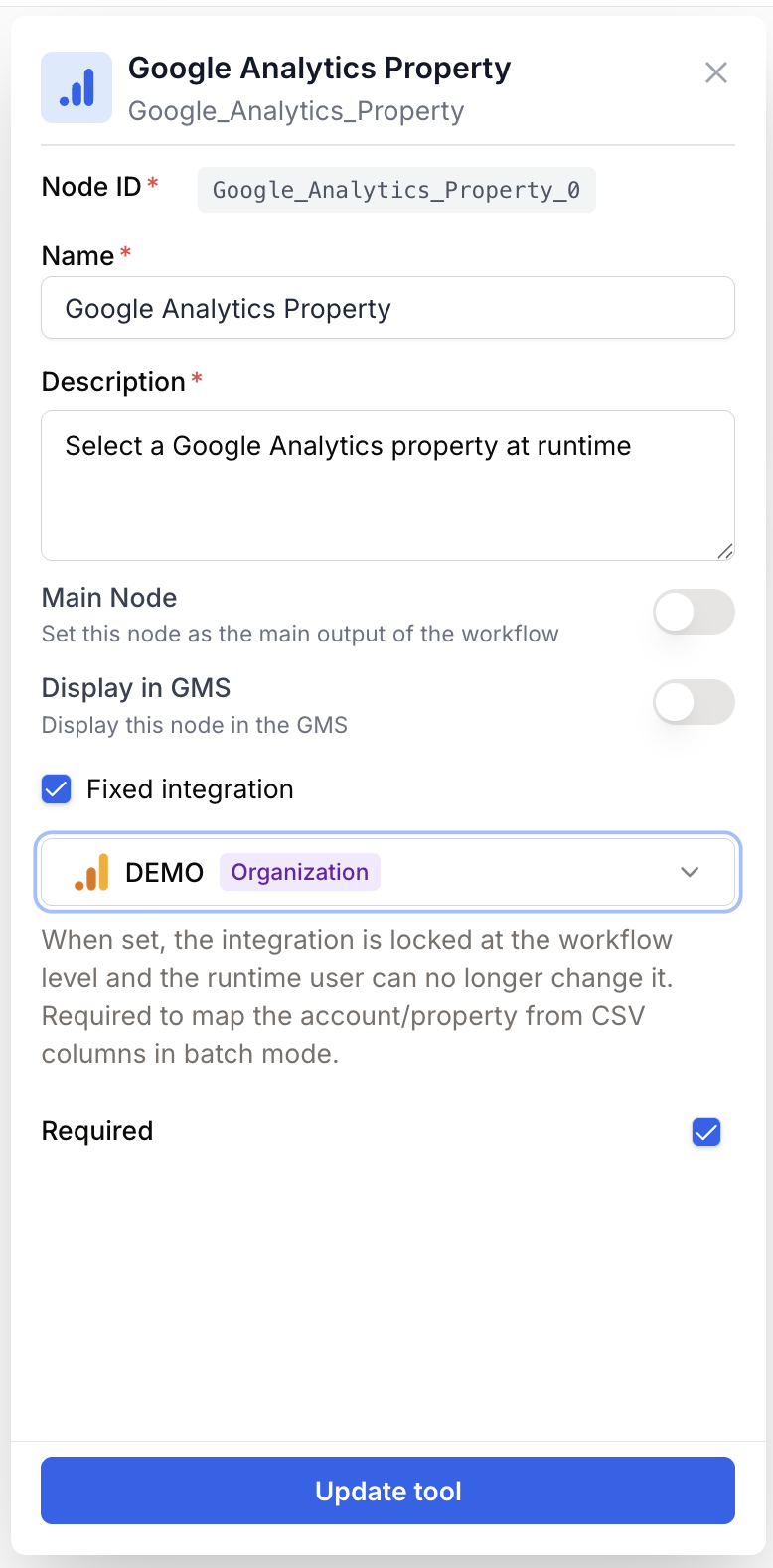
The node exposes minimal settings — most of the work happens at runtime when the runner selects the integration, account, and property.
Required fields
Name string required default: Google Analytics Property Node name — Used to identify the node in the workflow canvas and in App-tab labels (e.g. “Source GA property”).
Description string required default: Select a Google Analytics property at runtime Node description — A short phrase shown to the runner explaining what to pick.
Optional fields
required boolean default: true Required — Whether the runner must pick a property before the workflow can start. When disabled, downstream nodes must handle the case where no property is provided.
integration_id string Pinned integration — The ID of a specific Google Analytics integration to lock in for every runner. This field is only shown when the UI-only Fixed integration toggle is on; that toggle isn’t a saved parameter — it just controls whether integration_id is persisted. With the toggle off, integration_id stays empty and each runner picks their own integration at runtime.
Pinning a Fixed integration is the right choice when the workflow must always read from one company GA account (audit, internal report). Leaving it open is the right choice when each runner should bring their own GA credentials.
What does the node output?
The node has three string outputs that map to the GA Admin API resource names. Connect them to the matching input handles on the Google Analytics Reader tool node.
account_id string The selected GA account, formatted as accounts/123456789.
property_id string The selected GA4 property, formatted as properties/123456789. The Google Analytics Reader uses this value to query the GA Data API.
integration_id string The ID of the Google Analytics integration the runner picked (or the pinned one). Useful when downstream tool nodes need to use the same integration for related calls.
Usage examples
Example 1: Per-runner GA reporting
Build a single workflow that any team member can run on their own GA4 property.
Workflow:
- Google Analytics Property (input) — Runner picks their account and property at runtime.
- Google Analytics Reader (tool, with “Use variable” enabled on both account and property) — Fetch sessions and engagement data.
- LLM — Summarize trends and anomalies.
- Email Sender — Send the report to the runner.
Settings on the input node:
required=trueFixed integration= off (each runner brings their own GA credentials)
Example 2: Batch analysis across multiple properties
Run the same GA analysis on a list of properties from a CSV.
Workflow:
- Google Analytics Property (input) — In batch mode, map two CSV columns: one for
account_id, one forproperty_id. - Google Analytics Reader (tool, with variable toggles enabled) — The per-row property is queried.
- JSON Path Extractor — Pull key metrics from each response.
- Merge Lists — Combine all rows into a single report.
Sample CSV input:
account_id,property_id
accounts/111111111,properties/222222222
accounts/111111111,properties/333333333
accounts/444444444,properties/555555555
Common issues
The account or property dropdown is empty
Cause: The selected GA integration may not have access to any accounts or properties, or the OAuth token has been revoked.
Solution: Go to Settings > Integrations and verify the Google Analytics connection is active. Make sure the connected Google account has access to at least one GA4 property.
The GA Reader returns an empty result or an authorization error
Cause: The property picked here may not be accessible by the integration used in the GA Reader, or the GA Data API is not enabled for that property.
Solution: Verify that the integration in this input node matches (or has equivalent access to) the integration on the GA Reader tool node. Make sure the Google Analytics Data API is enabled in the Google Cloud project tied to the integration.
The downstream GA Reader ignores the values from this node
Cause: The “Use variable” toggles on the GA Reader’s Account and Property fields are off, so the reader uses its own hardcoded values instead of the wired inputs.
Solution: Open the GA Reader settings and enable “Use variable” on both Account and Property. The two toggles are linked — turning one on enables the other automatically.
Best practices
Pair this node with the GA Reader’s “Use variable” toggles on both Account and Property. The toggles are linked: turning the account variable on enables the property variable too (the property dropdown depends on the account). Use batch CSV mode with two columns (one for account ID, one for property ID) when scanning many properties — much faster than running the workflow once per site.
Match the GA API resource format. Account IDs must look like accounts/123456789 and property IDs like properties/123456789 — both with the resource prefix. Bare numeric IDs from a CSV column will be rejected by the GA Data API.
How does it fit into a workflow?
The Google Analytics Property node sits at the very start of a GA workflow, feeding runtime-selected resource IDs into a Google Analytics Reader.
graph LR
    GAP[Google Analytics Property
<br/>runner picks account + property] --> GAR[Google Analytics Reader
<br/>variable mode on Account + Property]
    GAR --> JSON[JSON Path Extractor]
    JSON --> LLM[LLM summary]
    LLM --> Email[Email Sender]
Related nodes
Query GA4 for sessions, users, and engagement metrics — the natural downstream node for this input.
Same idea for Google Search Console — let runners pick a Search Console property at runtime.
Let runners pick a Google Drive file at runtime.
Provide a free-text input at runtime when no integration picker is needed.